Radical Love. Kindness in action.
Radical Love. Kindness in action.

SEL Books for Boys:
Chapter Books That Actually Reach Them
For teachers, school counselors, and parents of boys who feel everything but say very little.
Most SEL books weren't written with boys in mind.
Walk into any elementary classroom and you will find a shelf of SEL books. Picture books about feelings, stories about sharing and kindness, characters who learn to use their words. Most of them are wonderful. And most of them will reach the girls in your class far more reliably than the boys.
That's not an accident. The vast majority of SEL picture books centre female characters or gender-neutral animals. The emotional vocabulary they use, the way feelings are named and processed openly and immediately, tends to align more naturally with how girls are socialised to relate to their inner world. For a boy who has learned that feelings are something you manage privately, or that expressing them makes you look weak, these books can feel like they're speaking a language he hasn't been taught.
This page is for the educators and parents who already know this, who have watched a boy sit through an SEL lesson and come out the other side unchanged, and who are looking for something that actually reaches him.
Why chapter books work for boys when picture books stop working
Around age seven or eight, something shifts. Picture books start to feel young to many boys, even the ones who are still figuring out big emotions. The format itself can become a barrier, because accepting that a picture book is speaking to you requires a kind of openness that a child who is already guarded about feelings is unlikely to offer.
Chapter books change that equation. A longer story gives a boy character time to actually live inside a difficult situation rather than resolve it in twelve pages. The emotional content arrives through action and consequence, through what the character does rather than what he says he feels. And because the reader is tracking a plot, following a person he's invested in across days and weeks of story, the emotional truth of that character's experience has time to settle in without ever being announced.
The best SEL chapter books for boys don't say "this is a book about feelings." They say "this is a book about a kid you might recognise." The feelings are in there. They arrive through the story. And for a boy who has learned to keep his guard up, that indirect path is often the only one that works.
A boy character who is specific, not symbolic
The character needs to feel like a real kid, with particular habits, a specific way of seeing the world, and flaws that aren't immediately corrected. A boy who recognises himself in a character will follow that character into uncomfortable emotional territory. A boy who sees a cardboard lesson with a face will put the book down.
A story that respects his intelligence
Boys aged 8 to 13 are perceptive readers of authenticity. If a story feels like it's trying to teach them something, they will resist it. If it feels like it's just telling the truth about what it's like to be a kid navigating something hard, they will read it cover to cover without realising the SEL competencies embedded in every chapter.
Emotions that arrive through action, not declaration
The best SEL books for boys don't have characters who sit down and explain how they feel. They have characters who do something, say something they shouldn't, go silent when they should speak, or keep moving when stopping would be braver. The emotional content is there, but it comes through behaviour, and boys tend to read behaviour fluently even when they can't articulate feelings directly.
The most effective SEL books for boys are ones that generate questions rather than answer them. A character who makes a complicated choice, whose feelings are messy and not fully resolved, gives a teacher or counselor a natural entry point: "What do you think Ray was actually feeling there?" That question is far easier for a guarded boy to answer than "How are you feeling today?"
Room for the conversation to happen after, not during
What makes an SEL book work for a boy aged 7 to 13
The Radical Ray series: SEL chapter books written with boys in mind


The Radical Ray series follows eight-year-old Ray Roxby, a cheeky, big-hearted boy growing up in Botany, Sydney, across four chapter books. Ray is not a lesson. He is a kid: specific, imperfect, funny in the way real children are funny, and carrying things that he doesn't always have words for.
The series was written by Bobbi Chegwyn, an Australian-born author with twenty years of background in human behaviour, who also drove a school bus full of third and fourth graders when she first arrived in the United States. What she saw on those rides, boys carrying things they had no words for, feelings showing up as behaviour and behaviour getting them in trouble, is what shaped every book in this series.
Each book targets a different emotional reality that boys in upper elementary classrooms face regularly, not as a curriculum, but as a story.
The four books
Book 1: Radical Ray: Australia's Little Champion for Big Change Ages 7–9 · Grades 2–4
Ray Roxby is eight years old, and he notices things. The kid sitting alone at lunch. The new boy who doesn't know anyone. The moments where one small choice could change everything, or leave someone behind.
Most people walk past those moments. Ray can't. And for a boy in your class who has ever wanted to make a difference but wasn't sure where to begin, watching Ray figure it out is the entry point into something much bigger than a lesson about kindness.
Book 2: Radical Ray: A Father's Return Ages 9–12 · Grades 4–6
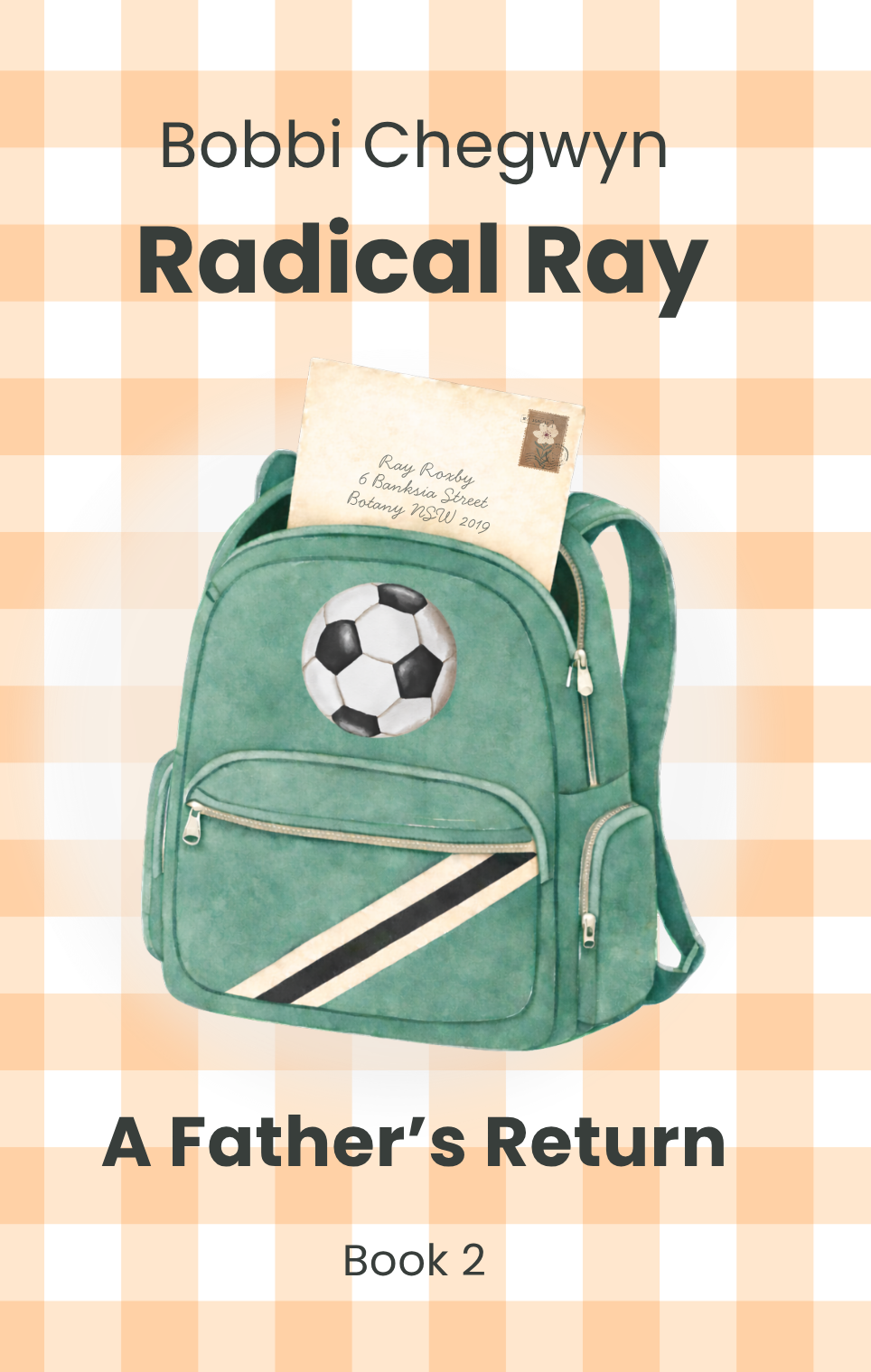
A letter arrives out of nowhere. Ray's dad is back after years away.
This book sits inside one of the most common and least-discussed emotional realities in upper elementary classrooms: a child navigating a complicated relationship with a parent who left. It handles forgiveness, trust, and family complexity without pretending any of it is simple.
Book 3: Radical Ray: The Too Much Moment Ages 9–12 · Grades 4–6

Ray starts making himself smaller to fit. Someone has told him he is too much, and somewhere along the way, he has started to believe it.
This book goes directly to the heart of self-worth and limiting beliefs in a way that reaches boys who have learned to shrink themselves in order to be accepted, a pattern that often shows up in classrooms as withdrawal, disengagement, or low confidence.
Book 4: Radical Ray: No Greater Love Ages 10–13 · Grades 5–7

Ray's mother dies. He keeps going to school. He keeps noticing things. He keeps his journal. And underneath all of it, he carries a weight he doesn't yet have words for.
This is the book for the boy in your class who is grieving and hasn't told anyone, the one who says he's fine and almost means it. It is honest, tender, and written by someone who has lived inside that particular silence.
A note for parents: the boy who won't talk about his feelings
If you are a parent rather than an educator, you may have landed here because you have a son who is carrying something and won't let you in. He says he's fine. He goes quiet when you try to talk. He's not shutting you out deliberately; he genuinely may not have the language yet for what he's feeling, or he may have learned somewhere along the way that having big feelings is something to manage privately.
A well-chosen book won't fix that overnight. But it can give him a character to think alongside, a story where someone like him is feeling something like this, and that can be the beginning of a conversation he couldn't start on his own. Leave the book on his nightstand. Read it yourself first. And when he finishes it, try asking what he thought of Ray rather than how he is feeling. The answer to the second question is often inside the answer to the first.
Questions teachers and counselors may ask
Why do boys respond differently to SEL books than girls?
Research in child psychology consistently shows that boys are socialised to suppress emotional expression from an earlier age than girls, and are more likely to express emotional distress through behaviour rather than words. This means that direct approaches to emotional learning, including many picture books and SEL worksheets that ask children to name and share their feelings openly, tend to be less effective with boys.
Stories that embed emotional content in action and consequence, where a character navigates something difficult without the story pausing to explain what he is feeling, tend to reach boys more reliably because they work with rather than against the way many boys process emotion.
What is the right age for SEL chapter books for boys?
Most boys are ready for SEL chapter books somewhere between ages 7 and 9, once they have moved past the stage where picture books feel naturally engaging. The Radical Ray series spans ages 7 to 13 across four books, with earlier books in the series suitable for grades 2 to 4 and later books designed for grades 5 to 7.
The most important factor is not age but engagement: a book that a boy will actually finish is more valuable than one that is technically age-appropriate but loses him in the first chapter.
Can I use these books in a school counseling session with a single student?
Yes, and this is one of the most effective uses of the Radical Ray series. Reading a chapter or a key passage with a student and then asking questions about the character, rather than the student directly, gives a guarded child a way into difficult emotional territory without feeling exposed. The discussion guides included in the series provide specific questions designed for exactly this kind of one-on-one use.
Are these books suitable for a class read-aloud?
Books 1 through 3 work particularly well as class read-alouds for grades 2 to 6. The Australian setting and the glossary of Australian words and phrases adds a cultural learning dimension that many teachers find genuinely useful, giving the class a shared reference point outside their own experience. Book 4 deals with grief and parental loss, and works best as a counselor recommendation or independent read rather than a whole-class read-aloud, depending on the composition of your class.
What educators and professionals say
"An excellent resource for assisting professionals. It's wonderfully written and the talking points are amazing. Highly recommend not only for professionals, but also parents seeking opportunities to explore kindness and healthy coping."
Melissa Kappes M.A., M.Ed., LPCC-S, Licensed Therapist and Co-owner, The Counseling Professionals
"Brilliantly done, and a book that would absolutely support any child experiencing a similar life event. 10/10 as a book addressing a tragic situation in a way that will resonate with a child going through it."
Kathryne Imabayashi M.Ed., B.S.Ed., Parents of Boys Coach, Early Years Specialist, Author
Ready to find the right book for the boy you have in mind?
All four Radical Ray books are available on Amazon. If you are a teacher or school counselor, the Educators page has discussion guides, CASEL alignment information, and everything you need to bring the series into your classroom or counseling program.